

Turnip - Photo by krossbow
The turnip or white turnip is a root vegetable. Some smaller varieties are grown for human consumption while others are used as fodder. The leaves are sometimes eaten as “turnip greens”.
Turnip grows in temperate climates. In some countries, the name turnip is used for the rutabaga, which is a related but different vegetable with yellow roots.
Names
Scientific
Brassica rapa var. rapa
Synonym
Brassica campestris esculenta
English
Turnip
White turnip
Dutch
Consumptieraap
Herfstknol
Herfstraap
Knol
Knolraap
Meiknolletje
Meiraap
Raap
Stoppelknol
Tol
French
Navet
German
Rübe
Speiserübe
Italian
Rapa
Taxonomy
Order
Brassicales
Family
Brassicaceae
Genus
Brassica
Species
Brassica rapa var. rapa (Turnip)
Basic information and facts
Origin:
Probably originates from West Asia and Europe. Turnip was first domesticated in India for its oil-bearing seeds.
Distribution:
Temperate regions worldwide.
Annual, biennial, or perennial:
Turnip is a biennial plant. The root develop the first year and the plant flowers in the second year.
Roots:
The edible root is a white, fleshy taproot.
Leaves:
Turnip leaves are sometimes eaten as “turnip greens”.
Climate and weather:
Cultivated in temperate climate.
Spacing:
Sow the seeds in rows 25 to 30 cm apart. Within the row thin the healthy seedlings to a spacing of 10 to 15 cm.
Propagation:
Turnips are grown from seeds.
Uses:
The roots of some smaller varieties are used for human consumption. Bigger varieties are used as feed for animals. Leaves are edible and used as a leaf vegetable called “turnip greens”.
Crop categories
Cool temperate crops
Forage and fodder crops
Leaf vegetables
Minor crops
Root vegetables
Temperate crops
Vegetable oils
Vegetables
Pictures

Turnip - Photo by looopeeelisa
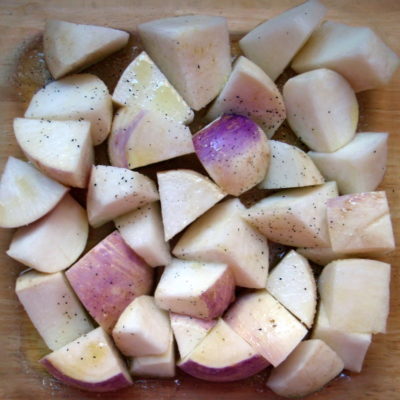
Turnip - Photo by joyosity

Turnips field - Photo by Dave-F

Turnip - Photo by tvol